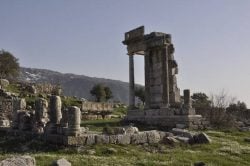
Located in Jbayl, el Mashnqa contains a Roman temple and ancient tombs with reliefs, one of which depicts a woman breastfeeding.
Note: Mashnqa comes from Canaanite’s ynq “to suck”. We see a pattern shift due to the reinterpretation to accommodate Lebanese Arabic word mashnqa which translates to gallows.
2. Maameltein, Arabic for ‘(the bridge of) the two administrative districts’
Located in Jounieh, this seaside area’s name refers to the bridge that connected the northern and southern administrative districts of Mount Lebanon under Ottoman rule.
Note: This the Arabic dual form of standard Arabic word muʿāmala which means province or district.
A photo posted by FFA Real Estate (@ffarealestate) on
In this town of Bikfaya, situated in the Metn region, there is a cliff that passes through most of the village, today over-shadowed by high buildings; the most dense and oldest parts of the village lie right below the cliff.
Note: Bə is Aramaic’s short form bət which means house, temple, family, place. Kfayya is the plural of Aramaic’s kēp̄ or kēp̄ā meaning rock or stone.
This village is situated on a ledge above Qadisha valley; hence, the meaning of its name: the place by the valley. It is Gibran Khalil Gibran’s residence, also known as that place where I was trusting (or crazy) enough to follow the Aussie – in his own words – on a few “madcap adventures…ending up shivering in deserted snowfields and getting lost clambering over mountainsides in the dark”!
Note: The b comes from Aramaic’s short form bət meaning house, temple, family, place, and sharra, an Aramaic word for valley.
5. Bourj Hammoud, Arabic for ‘the tower, turret of Hammoud’
Local tradition says that the ruler of Ehden offered the ancestors of those who settled in this locality a lot of land to keep their sheep and cattle. When they chose a small parcel of land between two rivers (Nahr Qadisha and Nahr Rashain), he said to their leader zeġġarta “you chose a small one [lit.: you made it small]”.
Note: This form, which is similar to Lebanese zġīr, ṣghīr is a hybrid of Aramaic zʿr and standard Arabic ṣġr, both meaning small or young.
Located in Keserwan, the river Nahr el Kalb is nearby and the inhabitants at times hear its ‘roar;’ the village was much closer to the river, but with time moved to the top of the hill.
Note: Aramaic’s gəʿī, gəʿā, Hebrew’s gāʿā, and Syriac’s gəʿo all mean “to roar, to low”. Canaanite’s gʿ means lowing, roaring.
8. Beirut, Canaanite for ‘(the place of the) wells’
A post shared by Live Love Beirut (@livelovebeirut) on
If you’ve lived in Beirut long enough, you’ve been favored to experience the city’s (and country’s) infamous water issues. So ironic that a city that is named after its underground water reserves contains such major water supply cuts.
Note: Beirut comes from the plural of Canaanite’s b2r ‘well.’
The Crusaders, who also coined the place-name, founded a Cistercian abbey here in the Koura district. It is now an Orthodox monastery where the University of Balamand was established.
Note: Bala comes from French’s bel which translates to handsome, beautiful and mand from French’s mont which translates to mountain, hill.
10. Laqlouk, Lebanese Arabic for ‘the glittering (place)’
Wardini was told that the name was given to this region, situated at an altitude of 1850 meters in Jbayl, because of its fine and pure weather, with seldom any fog; they say that the weather biylaqləq meaning it glitters. Tula Khandjian told the author that in her interviews a lady asked: “See the hills [that surround the region], are they straight?” The answer was: “La’ luq“, translating to: “No they are crooked”.
Note: The name comes from Lebanese Arabic laqlaq meaning to glitter or shine.