
Blog
Lebanon Just Standardized How Much Driving Schools Can Charge You
If you have ever felt like driving school pricing in Lebanon was a bit of a mystery, that is about to change. The Ministry of Interior and Municipalities has issued Decision No. 825, dated July 8, 2026, signed by Minister Ahmad Al-Hajjar, laying out a unified, standardized fee structure for driving schools nationwide.
Here is how it works:
This new regulation is essentially an hourly package system designed to stop schools from overcharging you. Before you begin training, the school gives you a mandatory 40-minute evaluation session, which is capped at 1,350,000 LBP. Based on how you perform, you are placed into one of five skill levels: very good, good, average, weak, or very weak.
Instead of forcing everyone to pay for a massive, full-length beginner’s course, the ministry is now tying your total bill directly to the number of hours you actually need. For example, if you already know how to drive safely, you will be graded “Very Good” and only legally require 5 total hours of brief theory and road checks before the exam. This means you only pay the lowest baseline fee of 11,250,000 LBP. If you have never touched a steering wheel, you will be graded “Weak,” requiring extensive, hands-on instructor time totaling 11 hours, which bumps the total package cap to 22,950,000 LBP.
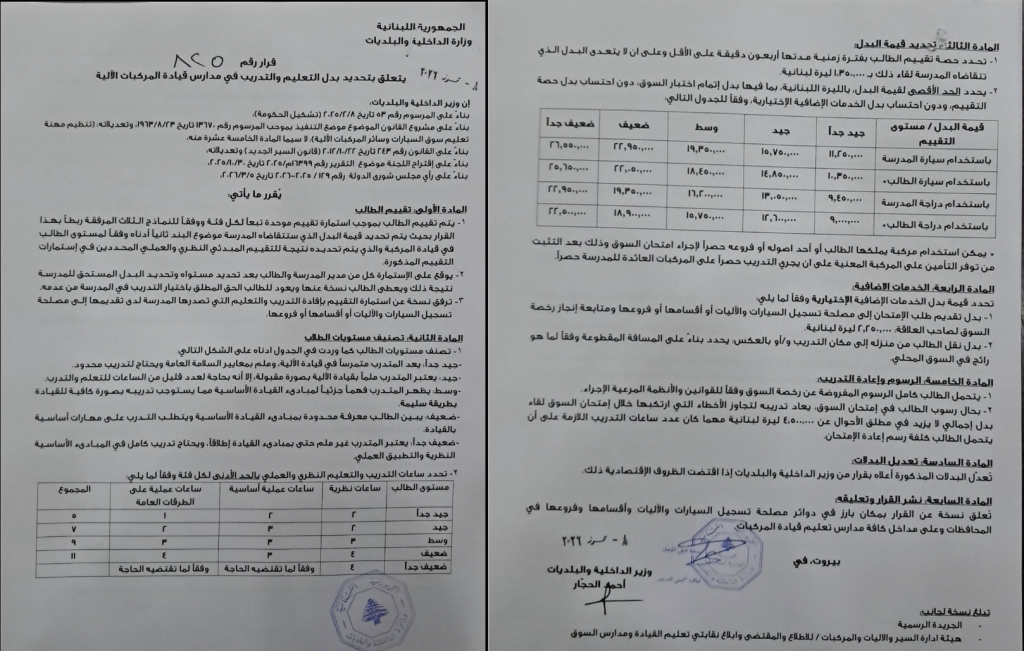
These total package prices assume you are using the school’s car. The caps drop slightly if you bring your own vehicle or if you are training on a motorcycle instead. Using the school’s own car naturally costs more to cover vehicle wear, tear, and insurance.
The decision also regulates extra services that used to be a major grey area. Students can pay an optional fee, capped at 2,250,000 LBP, to have the school submit and follow up on their license paperwork through the Vehicle Registration Department, known as the Nafaa. There is also a regulated fee for transporting the student from their home to the training site and back, which is scaled to distance and local market rates.
Is it actually fair?
It’s also worth asking who this system quietly favors. The fee tiers are meant to reward competence, not privilege, but competence at that first evaluation is rarely built in a vacuum. A student who grew up around a family car, with a parent willing to let them practice on quiet roads, is far more likely to walk in and test as “Good” or “Very Good.” Someone with no prior access to a vehicle will almost certainly land in “Weak” or “Very Weak,” facing both more hours and a bill more than double the baseline. The reform fixes real problems, mainly arbitrary overcharging, but it doesn’t fully erase the fact that some students arrive already ahead.
In short, it’s better than what we had!





Ardo: Beirut's New Neighborhood Bar & Kitchen
20 Sep 2026

Looking for something to do? I can guide you.
Or start with one of these